

Kate Bradley, Campaigns Officer at GMLC, discusses the results of our Long Covid and Work survey of 81 people suffering with Long Covid, and outlines recommendations for employers, employees and union representatives based on the results.
Lately, GMLC has been getting a lot of queries from employees and self-employed people who are struggling to work as a result of the after-effects of Covid-19. Covid-19 can cause symptoms for some people that can last weeks or months after the infection has gone, widely known as Long Covid.
NHS advises that Long Covid symptoms can include extreme tiredness (fatigue), shortness of breath, chest pain or tightness, problems with memory and concentration (“brain fog”), difficulty sleeping (insomnia), depression and anxiety, and other serious cognitive and physical problems.
Shirley’s story
I spoke to Shirley, who called us for advice on her situation at work. Shirley had been working in a supermarket when she caught Covid near the start of the pandemic, and then she caught it again later in the pandemic, also when she was back at work. She felt her employer took customers’ sides when they complained about having to follow Covid rules, such as wearing a mask, and it left her with little protection against catching the virus. She was generous towards her employer in that she recognised how difficult it was for them to get measures in place fast enough at the start of the pandemic in 2020, but as adherence to guidance became more lax, it was frustrating that customers’ preferences were being put before employees’ health.
The second time Shirley caught Covid, the after-effects were debilitating. She told me:
“It’s like you’re carrying round a massive carrier bag of symptoms with you all the time. Some symptoms are liveable but others are awful. The breathlessness, fatigue, depression and joint pain were there all the time. I’ve got no strength in my knees or elbows. The job is all lifting and twisting, so there was no way I could do my job after I developed Long Covid.”
Shirley had to take time off work claiming Statutory Sick Pay (SSP). “SSP is not enough”, she told me. “Luckily I don’t have a mortgage, but I still have all my bills to pay. If I’d have had a mortgage, I worry I would have lost my house.”
Shirley ended up claiming Universal Credit, but had lots of problems with the benefits system.
“You can’t get in touch with UC, they want you to do everything online and through apps, which was really hard, especially since I’m dyslexic. When applying for Universal Credit, the waiting times meant I had no money at all for weeks. One month, I got paid a retrospective bonus for working through Covid, an extra £200. I was pleased until I realised it would lead to my Universal Credit being reduced, leaving me with £0 extra! The company gave me a reward for my work and then the government took it back off me, and that I found shocking.
I’m still getting the lowest possible amount of Universal Credit while I wait for my medical assessment. I’ve been waiting at least 3 months and haven’t heard back. When I’ve called to chase it up, I’ve been told not to call. A lot of the phone lines aren’t working or are asking you not to call.”
Shirley told me she’s definitely not able to go to work most days, and she wishes Covid were classified as an industrial disease when it is contracted at work. She pointed out the hypocrisy of the situation, where keyworkers were risking their lives during the pandemic and then left with no support when they started experiencing Long Covid: “I was getting minimum wage and having to work my full hours and risk catching Covid, and then when I did get Covid, I was threatened with sacking and had to live on SSP.”
Long Covid and Work survey
Unfortunately, Shirley is not alone. As of 6 June 2021, the ONS estimated that there were 962,000 people living in private households in the UK (1.5% of the population) experiencing self-reported Long Covid (i.e. symptoms persisting for more than four weeks after the first suspected coronavirus infection that were not explained by something else).
As we received a growing number of queries, GMLC started speaking to Long Covid support groups. This included a group from the COVID-19 Long Haulers support group on Facebook that currently has over 45,000 members. Those who spoke to us were keen to get advice for themselves, but also asked us to support mounting challenges against their unfair treatment at work. Many were health workers and other keyworkers who had been at the front lines of caring for others during the Covid-19 pandemic, but who were now struggling with unsupportive employers, reduced incomes, or even dismissal as a result of their continuing Long Covid symptoms.
We decided to run a survey to collect more data on what people were experiencing. We hoped to use this to inform GMLC’s understanding of how Long Covid is affecting workers and what we should prioritise when fighting for better rights and protections. In just one week, after sharing in our newsletter and on social media, 81 people from Manchester and further afield had filled in the survey.
Although small, our sample reflected many trends in wider Long Covid data. For example, 85% of our sample were women, most of them between 36 and 55, reflecting previous statistics on Long Covid being more likely in working-age women. A majority of those who filled out the survey were healthcare workers, also reflecting wider trends (in April 2021, around 122,000 healthcare workers were experiencing Long Covid.)
Catching Covid at work: the importance of health and safety measures
One of the important things to consider when thinking about Covid and work is health and safety, and whether employees are properly safeguarded while at work. Our data suggested that, particularly at the start of the pandemic, there were not adequate protections in workplaces to protect employees from catching Covid. 49.4% of our survey participants were certain they caught Covid at work or on the way to work, and a further 16% thought that they had probably caught it at work or on the way to work. Of those who thought they caught Covid at or on the way to work, 45.3% said there were no safety measures in their workplace at the time.
Many of those who said there were no safety measures at work mentioned that they caught Covid in the first wave before official lockdown measures had begun. One clinical pharmacist, based at a hospital, said:
“No one was aware of needing to wear masks, social distance or avoidance of using recycled air conditioning or reducing numbers who work in a small area.”
Some felt that their employers could have been more responsive to the risks at the beginning of the pandemic. One employee who worked in conference environments said:
“At the time I caught Covid (February 2020) my workplace did not have any Covid safety measures in place. I had to present at an international conference in London organised by my employer during the first wave of the pandemic when all other events in our field were being cancelled. My employer chose otherwise. In retrospect it would have been sensible not to go ahead with the event or to hold it online.”
At the beginning of the pandemic in early 2020, there was criticism of the government for the delays in introducing adequate safety measures and policies to stop the spread of Covid. For this participant above, the UK’s late introduction of safety measures meant that her employer was free to make a decision about her work that had life-changing effects for her later. Our results showed that several participants were in a similar situation. Not only did hospitalisations and deaths increase as a result of slow and poorly thought-out policy-making, many Long Covid sufferers are still feeling the consequences of delayed lockdown and poor guidance to employers at the start of the pandemic.
The failures of employers to introduce proper health and safety measures in workplaces was highlighted starkly by one participant, who worked for the NHS as a call handler.
“As the service I was working for is an advice portal for Covid-19, they should have been more pro-active in putting safety measures in place at the workplace.”
Even later in the pandemic, when guidance had been issued, many employees had problems with their managers not being informed of workplace and government policies on Covid, especially where it differed for people with underlying health conditions. One NHS doctor who still has Long Covid symptoms told us:
“[D]espite national NHS guidance that I should be working at home as I was in the high-risk group for Covid-19 [due to] chronic asthma, my manager did not tell me to do this. […] I did two days of clinical work in a hospital (where I later found out there was Covid outbreak) when I should not have been working due to my increased risk factors and should have been working from home.”
It was very clear from our data that poor guidance and regulation from the government, a lack of health and safety measures at work and unsupportive management practices have had long-term and life-changing effects for workers.
Our survey has highlighted the importance of Covid risk reduction in the workplace, and the high stakes when employers fail to implement safety measures or adequately address concerns for vulnerable workers. Even though numbers of hospitalisations and deaths seem to have been reduced by the Covid vaccination, many people who contract Covid continue to suffer from Long Covid. It continues to be crucial for workplaces to minimise risks, especially in settings where the chances of catching the virus are high (e.g. hospitals or schools).
If you would like to get advice on how to make your workplace safer and fight for better protections at work, Greater Manchester Hazards campaign have produced a leaflet on controlling risks in the workplace, which you can download here.
Long Covid and the (in)ability to work: how did employers respond?
In our survey, the most common Long Covid symptoms our participants reported were fatigue, “brain fog” and shortness of breath, though joint pain, chest pain, insomnia, residual symptoms of Covid (such as loss of smell), pins and needles, nausea and depression/anxiety. It was striking how many people were experiencing several symptoms at once, suggesting that Long Covid has had far-reaching effects and affected both mental and physical aspects of our participants’ health.
97.5% of our participants said that Covid has affected their ability to work – 79 of the 81 people who responded to our survey. Of those who said Long Covid had affected their ability to work, 67% said that they could not manage a day of work due to their symptoms, and a further 27% said they could work for one or two days a week but would struggle to work more.
When we consider how many of the participants in our survey said they had been experiencing symptoms for more than 12 months, the picture becomes clear: many Long Covid sufferers are experiencing a severe, long-term and debilitating condition that heavily affects their daily lives.
Many employers seemed to be responsive to this and had provided reasonable adjustments, or treated employees on sick leave with compassion and patience. From the 54 participants who provided a written answer to our question about how employers had treated them, we extrapolated that 72.2% of those people had, overall, been supported by their employer or given reasonable adjustments to their working lives to help them cope with their symptoms. Some described their employers as “supportive” and “sympathetic”.
However, 27.8% of participants who answered this question told us that they had real difficulty getting support at work, and four participants had been laid off as a result of their symptoms. Participants commented that it was “difficult” to get support, or that they were put through standard absence procedures that did not take into account the persistence of their symptoms. Several commented that they had been “disbelieved” or “belittled”. One participant said their experience had been “terribly negative”.
A former worker in financial services commented:
“Work put me in a position of having to fight my corner for 6 months. Instead of supporting me to recover, and wanting to understand the impact of symptoms, I had to fight for my job and health at every meeting, until they sacked me.”
Another who is currently on leave from their office-based role commented:
“They are trying everything to get me back to work by hook or by crook, and don’t seem to care that I am sick & suffering with little or no help in sight. At one point they even tried to make out that my Long Covid symptoms e.g. joint pain etc. were not related to Covid and tried to dismiss me using sickness procedures.”
Amongst employers who responded poorly, there seemed to be little recognition of the seriousness of Long Covid and how debilitating symptoms can be. Reliance on inappropriate sickness absence procedures was a theme, even for workers employed by the NHS:
“I was rapidly processed through the sickness absence procedure and told to “get some fresh air”. I was invited to the first formal meeting by text, with less than a week’s notice and without being informed I could have a union rep present. I had to fight for months for my illness to be recognised as Covid-related.”
When we asked what changes would have helped our participants through their experience of Long Covid, 95.1% of our participants wanted employers to know more about Long Covid so they realise it is a serious illness and take into account guidance on how to treat employees. Employers and employees can get guidance on Long Covid from Acas here.
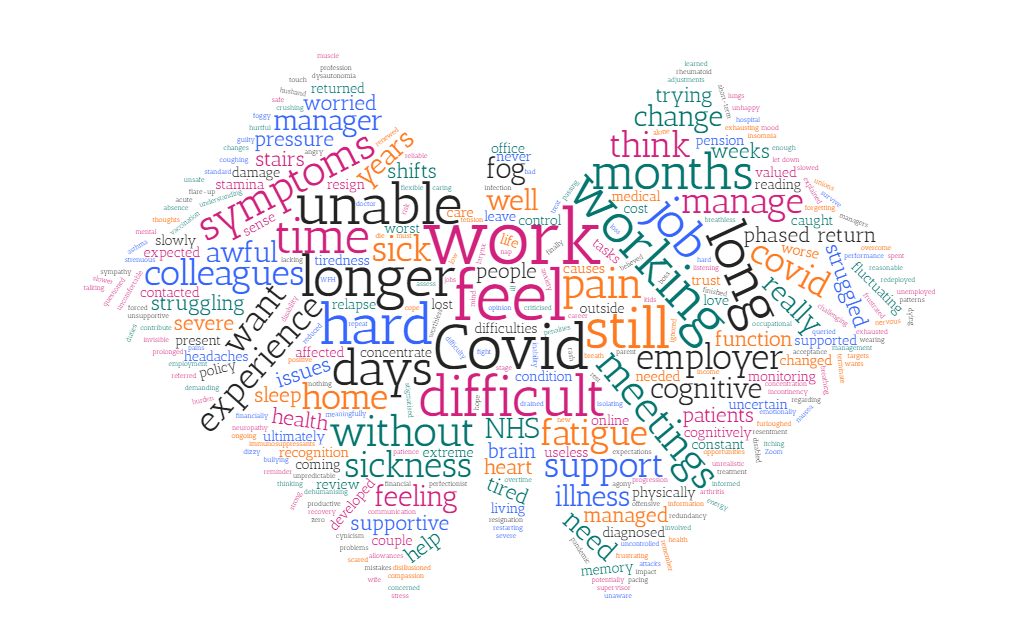
A word cloud visualising the words used most frequently in the Long Covid and Work survey when we asked about how employers treated our participants when they got Long Covid.
Long Covid and disability discrimination
There are many reasons that those experiencing Long Covid might want to have it considered a ‘disability’. Having an illness classified as a disability means that employees have more protections due to the Equalities Act 2010. This means employers may tread more carefully before treating a disabled employee unfairly or sacking them as a result of their illness. If they mistreat an employee on the basis of a disability, the Act allows employees to hold their employer accountable for any discrimination, either through their union, in mediation, or by taking a case to the employment tribunal.
Under the law, a disability is a physical or mental impairment that has a ‘substantial and long-term’ negative effect on a person’s ability to do normal day-to-day activities. ‘Long-term’ means that it must have lasted or be likely to last for at least 12 months. Insofar as our data is reflective of wider trends amongst Long Covid sufferers, both of these conditions would be met easily by Long Covid. Many participants described being unable to get out of bed, to concentrate, or to carry out daily chores and tasks to look after themselves. 75.3% of our participants had been experiencing symptoms of Long Covid for more than 12 months, even though the first wave of the pandemic across the UK only began around 18 months ago.
Nevertheless, Long Covid sufferers have an uphill battle to fight to get Long Covid classified as a disability. Though some employers may choose to treat Long Covid as a disability as part of best practice, others will wait for the issue to be determined at an employment tribunal, which could take years. Barriers to access to justice will also stand in the way: although legal aid (financial help with paying for legal action) is available for discrimination cases in employment law, anyone still working would be unlikely to qualify under the means test, which requires a very low income. If someone has been unlucky enough to get so ill they cannot work at all, a lengthy and stressful court case is likely to be an unappealing prospect. We campaign for better legal aid provision to try and reduce these financial barriers to justice.
Despite these barriers, our survey does suggest that there is a significant number of possible litigants who may be in a position to take a case forward. The appetite for classifying Long Covid as a disability was huge amongst our participants. When asked what changes would have benefitted them in their struggle with Long Covid, 98.8% of our participants wanted to see Long Covid to be considered a disability in law. Managing to get Long Covid classified as a disability in law would open up discrimination cases (and also legal aid) as a recourse for those being mistreated at work, where currently, many are left with no legal protections at all.
The Trades Union Congress (TUC) has also called for Long Covid to be recognised as a disability. They completed a much larger survey of individuals with Long Covid, but like us, found clear evidence that Long Covid can be debilitating and long-term and therefore explicit protections are needed in law to ensure workers do not get treated unfairly as a result of their condition.
Long Covid and the benefits system
At the end of our survey, we asked some final questions about whether our participants had applied for benefits, and how they had found the benefits system. Most who had applied for benefits raised the issue of the complexity and difficulty of the process. Many were annoyed with the outcome, especially in the case of those applying for the Personal Independence Payment (PIP), where there seemed to be inconsistency around whether their Long Covid symptoms were considered enough to merit a PIP award.
“I’ve applied for PIP but been turned down twice and going to tribunal. The assessor twisted what I said and blatantly lied on my assessment. The whole benefits system stinks. I didn’t ask to end up like this and there are thousands like me.” – Restaurant worker
“I have made a PIP claim but do not know the outcome. The form was difficult to complete in my current health.” – Probation office team leader
A nurse at a hospice summarised these frustrations succinctly:
“The benefits system needs to recognise Long Covid and its many symptoms and make the process easier and quicker. I need help now, not in a year after I’ve lost my job.”
80.2% of our participants thought that improved sickness-related benefits would have helped them during their experience of Long Covid. 48.1% would have been helped by increased SSP amounts.
Our recommendations
- The data suggested it is a priority for Long Covid to be determined a ‘disability’ for the purposes of protecting employees against discrimination on the basis of their experience of Long Covid. This seems particularly pertinent given so many people appear to have caught the virus at work while on the front lines of the Covid-19 pandemic.
- We recommend that employers seek out guidance and train all management staff to ensure consistency in the seriousness with which Long Covid is addressed. Employers should take a supportive approach towards employees, in line with guidance such as Acas’ here: org.uk/long-covid
- We recommend that workplaces continue to implement health and safety measures at work to ensure Covid does not continue to be spread in workplaces, especially healthcare settings. Adequate health and safety provision is a legal requirement.
- We suggest that benefits assessors are provided with detailed guidance around Long Covid to ensure that sufferers can obtain an income during periods when they are unable to work. This survey has shown, alongside many other pieces of research, that the system treats people facing ill health in a punitive and demanding way, which we consider to be unfair.
- We recommend a raise in Statutory Sick Pay and other sickness-related benefits for all claimants, and a less punitive benefits system that leaves people able to access the support they need without unnecessary barriers.
- We recommend that all employees join a trade union if they are not currently in one to enable effective negotiation and protection against poor health and safety practices, discrimination and redundancy.
You can download our full results from the Covid and Work survey here: Long Covid and Employment Rights survey results August 2021. We have also produced some preliminary guidance on Long Covid and your rights as an employee here. GMLC is currently working with other Law Centres to develop a joined-up response from the community advice sector.
If you’re having problems with employment or benefits as a result of Long Covid and you live in Greater Manchester, you can contact us for advice on your legal rights using our Help & Advice and Contact pages above.
Thank you to GMLC Campaign Volunteer Lead Daniel Doody for his research and analysis of the results.
Useful links and guidance
- GMLC, Long Covid and Employment Rights survey results August 2021
- ONS, Prevalence of ongoing symptoms following coronavirus (COVID-19) infection in the UK: 1 July 2021
- NHS, Long-term effects of coronavirus (long COVID)
- Acas, Long COVID – advice for employers and employees
- GMLC, Long Covid and your employment rights
- TUC, TUC calls for long Covid to be urgently recognised as a disability to prevent “massive” discrimination
- Citizens Advice, Protected characteristics
- GOV.UK, Civil legal aid – means testing


